
Antonio’s Coffee Journey
Meeting Ricardo from Gud Coffee Lab: When Engineering Meets Coffee
A personal conversation about Mexican specialty coffee, roasting, engineering, curiosity and the vision behind Gud Coffee Lab.
There are conversations that start with coffee and slowly become something else.
At first, I simply wanted to understand more about Gud Coffee Lab, the small Mexican coffee project behind two coffees that had recently arrived in my hands: a Marsellesa from Xilitla, in the state of San Luis Potosí, and a Typica from Oaxaca. I wanted to know who was behind them, how they were roasted, what kind of vision guided the project, and why these coffees felt like such an interesting entry point into Mexican specialty coffee for me.
But the more I spoke with Ricardo, the more I realized that this was not only a conversation about coffee.
It was also a conversation about method.
About control.
About curiosity.
About what happens when someone with an engineering mindset starts looking at coffee not only as a product, but as a process — something alive, complex, measurable, repeatable, and yet still deeply human.
Ricardo is the person behind Gud Coffee Lab. He works in the aeronautical field, and coffee is not yet his full-time job. It is his passion, his project, and maybe one day something much bigger. For now, he roasts using a machine rented at Alta Nota, a coffee shop and roasting space where he has been able to learn and grow with the help of Rodri, the roaster who has supported him along the way.

And honestly, that is one of the things I liked the most.
Gud Coffee Lab does not feel like a polished commercial story created in a marketing office. It feels like a real project, made by someone who is building something step by step, with patience and intention.
Someone who is trying to understand coffee deeply before trying to sell a dream around it.
Follow the project
Gud Coffee Lab
You can discover Ricardo’s coffee project directly on Instagram.
Visit Gud Coffee Lab on InstagramCoffee through the eyes of an engineer
One of the most interesting parts of my conversation with Ricardo was how naturally engineering entered the discussion.
Maybe it was because we both come from the aeronautical world. In that field, nothing is left vague. Every step matters. Every parameter matters. Everything needs to be controlled, checked, documented and, when possible, repeated.
A small variation can have consequences. A small signal can reveal something important. A process is not only something you perform; it is something you observe, measure and improve.
And when Ricardo spoke about coffee roasting, I could feel the same kind of logic.
Specialty coffee, at least when taken seriously, is not only about saying that a coffee tastes good. It is about traceability, quality, consistency and respect for the work that came before the roasting stage. The producer, the variety, the process, the altitude, the drying, the storage, the roast profile — everything leaves a mark.
For Ricardo, roasting is not a random act of transformation. It is a controlled process where each detail can change the final cup.
Temperature, time, airflow, humidity, first crack, development, cooling: these are not abstract words. They are variables. And like every variable in a complex process, they need to be understood.
One detail that really stayed with me was when Ricardo explained the connection between his work in methodology, especially around machine tools such as CNC systems, and one of his ideas for coffee roasting.
In machining, acoustic sensors can be used to detect abnormal oscillations or vibrations in a rotating cutting tool. In other words, sound can become a signal. It can tell you that something is happening before it becomes visible, before the problem becomes obvious.
And from there came an idea: could acoustic sensors be used in coffee roasting to detect the first crack more precisely?
For someone outside roasting, this might sound like a very technical detail. But in reality, it says a lot about Ricardo’s way of thinking.
He is not looking at coffee only with romantic eyes. He is looking at it as a system. A beautiful system, yes, but still a system. Something that can be listened to, studied, adjusted and improved.
And I find that fascinating.
Because specialty coffee is often described with poetic words: floral, bright, juicy, sweet, complex, elegant. And those words are useful. They help us describe the cup. But before the cup becomes poetic, it is also physical, chemical and technical.
Behind a beautiful coffee there is a chain of decisions.
Ricardo seems very aware of that.
Gud Coffee Lab: more than a name
The word “Lab” in Gud Coffee Lab feels very appropriate.
Not because the project is cold or clinical. Not at all. But because there is a real sense of experimentation behind it.
A laboratory is a place where you test, observe, compare and learn. It is a place where failure is not necessarily a problem, as long as it teaches you something. And coffee, especially for people like me who are still learning, is exactly that kind of world.
Every brew is a small experiment.
Every grind size changes something.
Every method reveals a different side of the same coffee.
This is also why Ricardo’s approach felt very close to the spirit of my own blog. I am not a professional barista. I am not a roaster. I am simply someone who is trying to understand coffee better, one brew at a time.
And in many ways, Gud Coffee Lab feels like a project created by someone doing something similar, but from the roasting side.
Ricardo is not just trying to make coffee. He is trying to understand it. To control it without killing its personality. To repeat quality without making the process soulless. To build something serious without losing the curiosity that probably started everything.
That balance is not easy.
Coffee can become too romantic, where everything is emotion and nothing is precise.
But it can also become too technical, where everything is data and the pleasure of drinking disappears.
What I liked in Ricardo’s vision is that he seems to stand somewhere between the two.
A foot in engineering.
A foot in coffee.
And maybe that is exactly where Gud Coffee Lab finds its identity.
My first real door into Mexican specialty coffee
Before discovering Gud Coffee Lab, I had almost no direct experience with Mexican specialty coffee.
Of course, I knew that Mexico produces coffee. I knew that different regions, altitudes and varieties existed. But in my personal coffee journey, Mexican coffees had never really been present in the same way as coffees from Ethiopia, Colombia, Brazil, Guatemala or Kenya.
I do not want to make big claims about the global coffee market, because I do not know enough to say why Mexican specialty coffee seems, at least from my limited European perspective, less visible than other origins.
Maybe it is an export question.
Maybe it is a market visibility question.
Maybe it is simply my own limited exposure.
But what I can say is this: Gud Coffee Lab became my personal entrance into Mexican specialty coffee.
And that matters.
Because sometimes one coffee, one roaster, or one conversation is enough to open a new door. Not necessarily because it gives you all the answers, but because it makes you want to ask better questions.
Where does this coffee come from?
Who produced it?
Why does it taste like this?
What does this region usually express?
How much of what I taste comes from the variety, the process, the roast, or my own brewing choices?
That is the kind of curiosity I like.
And it is exactly the kind of curiosity that specialty coffee can create when it is approached in the right way.
The two coffees: Marsellesa and Typica
The two coffees from Gud Coffee Lab that I will explore in the next articles are very different, and that is what makes the project even more interesting.
Coffee One
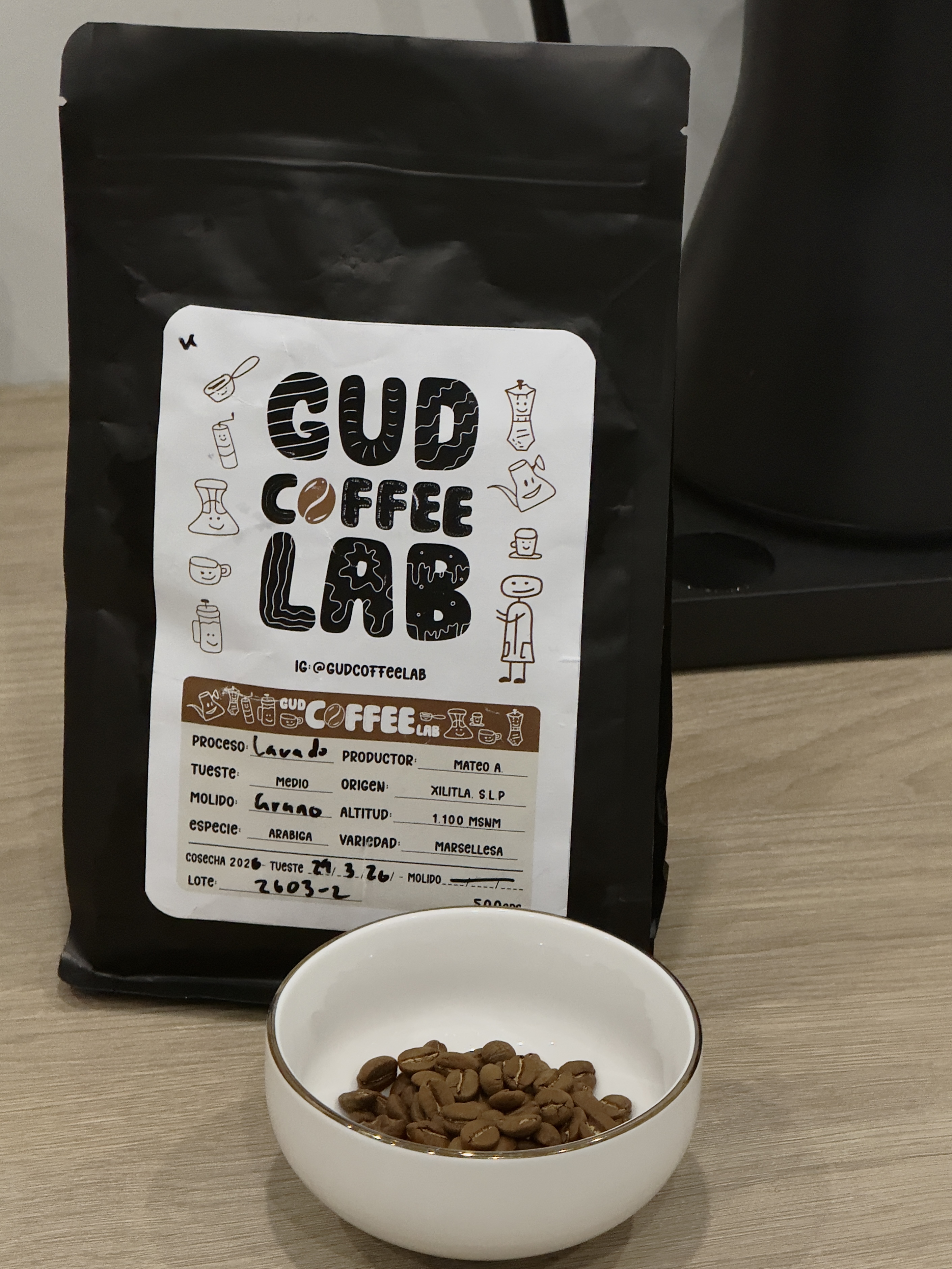
Marsellesa
From Xilitla, in the state of San Luis Potosí. A washed coffee with a medium roast.
Coffee Two
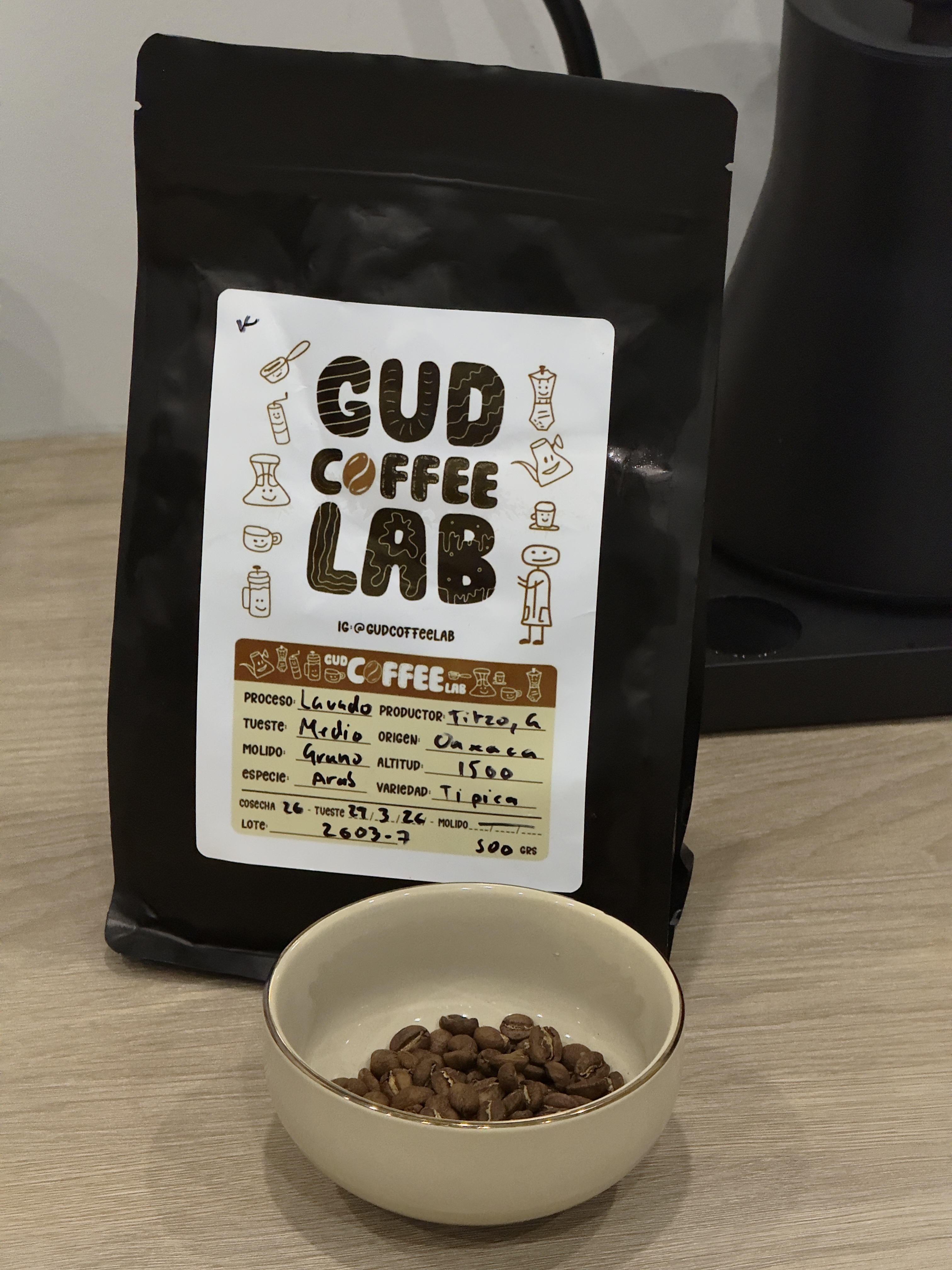
Typica
From Oaxaca. Also washed and medium roasted.
Two Mexican coffees.
Two varieties.
Two origins.
One roaster.
And three brewing methods.
I have already started exploring them with the V60, the moka pot and the AeroPress, and I can already say that each method tells a different story.
This is one of the things I love most about coffee at the moment. The same beans can become very different depending on the tool you use, the grind size, the water temperature, the ratio, the pouring structure, the pressure, the contact time, and even the small mistakes you make along the way.
V60
Clarity, acidity and aroma.
Moka Pot
Body, sweetness and intensity.
AeroPress
Somewhere in between.
And sometimes, the same coffee that feels closed or bitter in one method can suddenly open up in another. Or the opposite: a coffee that seems elegant in V60 can become difficult to manage in moka.
That is why I do not want to write only one article saying whether I “liked” these coffees or not.
That would be too simple.
Instead, I want to explore them.
I want to see how they behave.
I want to make mistakes with them.
I want to understand what each brewing method reveals and what it hides.
And in a way, this feels coherent with Ricardo’s own approach: coffee as a process of observation.
Specialty coffee should not feel intimidating
One of the subjects that came naturally during our conversation was accessibility.
Specialty coffee can sometimes feel intimidating. Expensive machines, complicated recipes, professional grinders, precise kettles, perfect water, extraction theory, refractometers, cupping protocols, roast curves, processing methods — for someone who is just starting, it can feel like too much.
And I understand that feeling very well.
For a long time, I also had some wrong ideas about filter coffee. I thought it was probably just a watery and bitter drink. Something weak, thin, without the intensity I associated with “real coffee”.
Then I tasted a well-prepared V60.
And I had to change my mind.
A good V60 can be clean, aromatic, delicate, bright, almost tea-like. It can show a side of coffee that espresso or moka do not always reveal. Not better in an absolute sense, but different. More transparent, maybe. More open.
Ricardo also seems to appreciate the V60 for that reason. It is a method that can show the potential of a specialty coffee with clarity. It does not hide much. When it works, it lets the coffee speak.
But at the same time, I do not think specialty coffee should belong only to people with expensive equipment or professional setups.
This is something I care about a lot in my own journey.
Yes, a good grinder helps.
Yes, technique matters.
Yes, water matters.
But specialty coffee should still be approachable.
You should be able to discover something beautiful with a V60, an AeroPress, or even a moka pot. Maybe not with perfect extraction. Maybe not with competition-level precision. But enough to understand that coffee can be more than a bitter habit.
I even brought some of Ricardo’s coffee to the office and prepared it with a moka pot. And what I liked was seeing people react with curiosity. Not everyone needs to become a coffee geek. Not everyone needs to know what Marsellesa or Typica means. But sometimes, when someone tastes a coffee that is different from what they expect, something changes.
They ask a question.
They notice sweetness.
They notice acidity.
They notice that it does not taste like the coffee they usually know.
And that small moment is already important.
For me, that is one of the best ways to talk about specialty coffee: not by making people feel ignorant, but by making them curious.
Industrial coffee, specialty coffee, and respect
I also think it is important not to turn specialty coffee into a war against industrial coffee.
I do not like the idea of simply saying that everything outside specialty is bad. Coffee is cultural, personal and emotional. Many people grew up with moka, supermarket coffee, capsules, dark roasts, family habits and simple daily rituals. Those things are real. They matter.
The point is not to insult what people already drink.
The point is to show that another world exists.
A world where origin matters more.
Where the work of producers is more visible.
Where roasting tries to reveal rather than erase.
Where brewing becomes a way to explore instead of just a way to get caffeine.
This is why projects like Gud Coffee Lab are interesting to me. They create a bridge. They are not only selling coffee; they are offering a different relationship with coffee.
One that is more transparent, more intentional, and maybe also more respectful.
Respectful of the producer.
Respectful of the process.
Respectful of the person drinking the final cup.
Ricardo’s dream
What I found most human in Ricardo’s story is that Gud Coffee Lab is still in motion.
It is not finished.
It is not a big established roastery with a perfectly controlled image and a huge infrastructure behind it. It is a project being built while Ricardo continues his main work in the aeronautical field.
He currently roasts with a rented machine at Alta Nota, with the support and experience of Rodri, the roaster there, who has helped him a lot in his learning process.
He tests.
He learns.
He improves.
He dreams.
And maybe one day, Gud Coffee Lab will grow into something bigger. Maybe one day he will have his own roasting machine. Maybe his coffees will reach more cafés. Maybe the project will become a more central part of his life.
There is something very beautiful about that stage of a project.
The moment where everything is still fragile, but also full of possibility.
The moment where passion is not yet comfort.
The moment where every batch, every customer, every conversation and every mistake still matters deeply.
I think that is also why I wanted to write this article before publishing my brewing notes on his coffees.
Because before talking about grind size, water temperature, recipes and extraction, I wanted to talk about the person and the vision behind the beans.
I wanted to understand where these coffees came from, not only geographically, but also emotionally and intellectually.
And now, every time I brew them, I do not only see “Marsellesa” or “Typica” written on a bag.
I see a small project in Mexico.
I see an engineer listening for first crack.
I see someone trying to combine precision and passion.
I see Gud Coffee Lab.
Coming soon
Two coffees, three methods
This article is also the beginning of a small series on the blog. In the next articles, I will explore the two coffees from Gud Coffee Lab through three different brewing methods: V60, moka pot and AeroPress.
Not as a professional review.
Not as a definitive guide.
But as a personal coffee journey.
I want to show the tests, the errors, the adjustments, the cups that did not work, and the small victories that made the coffees finally open up.
Because for me, this is where coffee becomes interesting.
Not when everything is perfect from the first attempt.
But when you slowly begin to understand what the coffee is asking from you.
Sometimes it asks for a coarser grind.
Sometimes for lower temperature.
Sometimes for a different ratio.
Sometimes it simply reminds you that you still have a lot to learn.
And honestly, that is probably why I enjoy this world so much.
A question for you
I would love to know your experience too.
What was the coffee that changed your mind about specialty coffee?
And have you ever brewed the same coffee with different methods — like V60, moka pot and AeroPress — and felt as if each method told a different version of the same story?
For me, Gud Coffee Lab was my first real door into Mexican specialty coffee.
And now that the door is open, I am very curious to see where it leads.
 Antonio's Coffee Journey
Leave a comment