
Antonio’s Coffee Journey
Gud Coffee Lab Marsellesa: The V60 Recipe That Finally Made It Speak
A small V60 journey through bitterness, temperature, grind size, and the moment when a difficult coffee finally became sweet, fruity, round, and expressive.
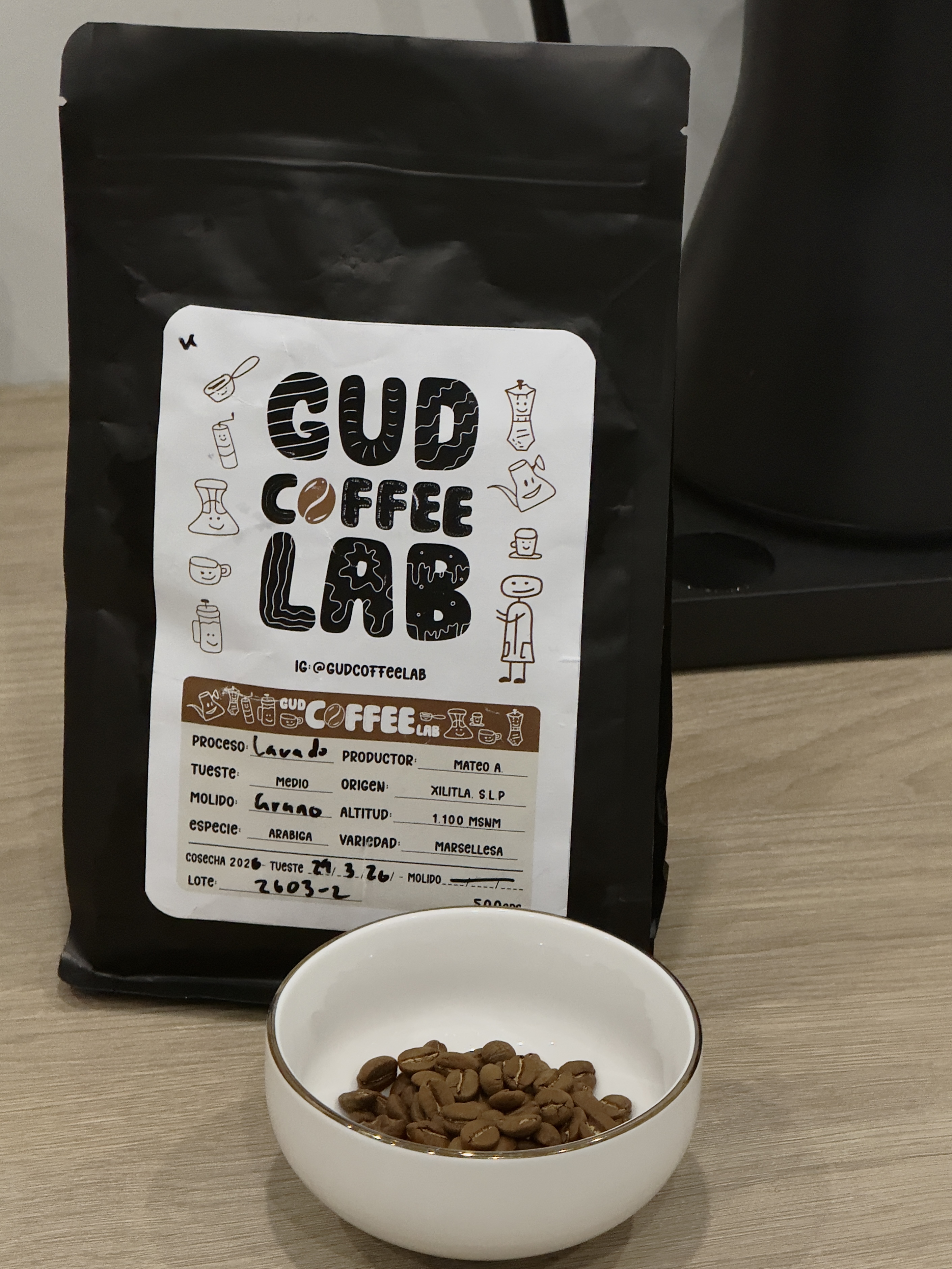
There are coffees that immediately tell you where they want to go.
And then there are coffees that make you work a little.
This Marsellesa from Gud Coffee Lab definitely belonged to the second category.
At first, I thought it would be quite straightforward. A washed Mexican coffee, medium roasted, from Xilitla, San Luis Potosí, grown at around 1100 meters. A Marsellesa variety. Something that, in my mind, could probably give me a balanced and accessible V60: maybe some sweetness, a gentle acidity, a soft fruitiness, and a round cup.
But the first brews did not really go that way.
The coffee was not bad. That is important to say. It was never unpleasant in a dramatic way. But it felt as if something inside the cup was blocked. The aromas were there, but hidden. The cup had bitterness, sometimes a woody feeling, and yet it did not feel fully developed either. That is one of the most confusing things when dialing in a coffee: when a brew tastes both bitter and underwhelming at the same time.
“Normally, when a coffee is weak or empty, I tend to think: extract more. But this coffee reminded me that V60 is not always that linear.”
Sometimes a coffee does not need to be pushed harder. Sometimes it needs to be approached more gently.
A Coffee That Was More Than Just a Bag
This Marsellesa also had a slightly different meaning for me because it came from Gud Coffee Lab, the independent Mexican roasting project created by Ricardo.
After talking with him and discovering more about his way of approaching coffee, brewing this bag felt less like opening a random coffee and more like continuing a conversation.
Gud Coffee Lab is not a huge company. It is a personal project, built around curiosity, precision, and passion. And maybe that is why I wanted to understand this coffee properly. I did not just want to brew it once, decide that it was “too bitter”, and move on. I wanted to find what it had to say.

The Coffee
Roaster
Gud Coffee Lab
Origin
Xilitla, San Luis Potosí, Mexico
Variety
Marsellesa
Process
Washed
Altitude
1100 m
Roast
Medium · 29/03/2026
The First Direction: A Simple V60 Approach
My first idea was to keep things simple.
I wanted a clean V60 recipe, without too many variables, and without turning the brew into a complicated experiment from the beginning.
So I started with a fairly classic structure: 15 g of coffee, 225 g of water, a ratio of 1:15, a temperature around 90–91 °C, a bloom of 45 g for about 40 seconds, and a single pour up to 225 g.
On paper, it made sense. A 1:15 ratio seemed like a good way to give the coffee enough body without making it too concentrated. The temperature was not too high, but still high enough for a medium roast. The single pour was chosen to keep the extraction simple and avoid over-agitating the bed.
But in the cup, something was missing. The coffee had a little acidity, but it was very discreet. The aromatic side was shy. The cup felt light, but not in a beautiful tea-like way. It was more like a coffee that wanted to open, but could not. And despite this lack of expression, bitterness was still present.
The Brews That Mattered
First direction
Simple and classic
Recipe: 15 g / 225 g / around 90–91 °C / around 90 clicks K6 / 45 g bloom / single pour.
Result: drinkable, but muted. A little acidity, not enough aroma, and a bitterness that covered the cup.
Pushing extraction
Finer, but not better
Recipe direction: finer grind, around the mid-80s on the Kingrinder K6, still trying to unlock more aroma.
Result: more extraction, but also more bitterness and a woody feeling. The coffee became heavier, not more expressive.
Final recipe
Lower temperature, better balance
Recipe: 15 g / 225 g / 89 °C / 87 clicks K6 / 45 g bloom / single pour / no swirl.
Result: delicate acidity, sweet and fruity notes, round body, and a cup that finally felt balanced.
The Temptation to Push Harder
My first reaction was the most natural one: maybe I needed more extraction.
So I started moving in that direction. I tried going finer. I tried thinking about more structure in the pour. I explored the idea of giving the coffee more contact, more intensity, more extraction.
At one point, I moved toward a finer grind, around the mid-80s on the Kingrinder K6. The idea was simple: if the coffee was not aromatic enough, maybe the water was passing too quickly and not extracting enough from the coffee bed.
But the result was not what I wanted.
The cup became more extracted, yes, but not more elegant. Instead of opening the fruity and sweet side of the coffee, the brew started to become more bitter and woody. The body was there, but the cup did not feel more alive. It felt heavier, more closed, and less pleasant.
This was an important moment in the process, because it showed me that the problem was not only “lack of extraction”. It was more about balance. The coffee did not want to be forced. Grinding finer and pushing extraction did not reveal more beauty. It revealed more bitterness.
Temperature Started to Matter More Than I Expected
The biggest shift came when I started to think more seriously about temperature.
I often think about grind size first. It is probably the variable I change most naturally, especially with the Kingrinder K6, because it gives me a very clear way to move step by step.
But with this Marsellesa, temperature was just as important.
At 90–91 °C, the coffee was not terrible, but the bitterness was too present compared to the aromas. When I tried to push extraction, that bitterness became even more obvious.
So instead of going hotter, I went the other way. I lowered the temperature.
And this was probably the key decision.
At 89 °C, the cup became softer. The bitter and woody edge was reduced. The coffee started to feel rounder, sweeter, and more pleasant. It did not suddenly become a completely different coffee, but it finally began to move in the right direction.
Final recipe card
Gud Coffee Lab Marsellesa — V60 Recipe
Coffee
15 g
Water
225 g
Ratio
1:15
Temperature
89 °C
Grinder
Kingrinder K6
Grind
87 clicks
Bloom
45 g · 35–40 s
Pour
Single pour to 225 g
Agitation
No swirl
Total time
1:55–2:15
Result in the cup: delicate acidity, sweet and fruity notes, a round body, and a much better balance between structure and aroma.
The Cup That Finally Made Sense
This was the first cup where I felt that the coffee finally started to speak.
The acidity was delicate. Not sharp. Not aggressive. Just enough to give the cup some life.
The sweetness became more present. The fruitiness was clearer, but still soft. It was not an explosive or extremely bright coffee. It was more rounded, more comfortable, more balanced.
The cup had a good presence in the mouth. It filled the taste well, with a round and pleasant body. It felt sweet, gently fruity, and much more harmonious than the previous attempts.
And most importantly, the bitterness was no longer dominating the conversation. It was still a medium roast coffee. It still had structure. But now the structure was supporting the cup instead of covering the aromas.
What This Coffee Taught Me
Bitterness is not always simple
Some brews tasted bitter while still feeling underwhelming. That combination is difficult to read, because it does not give you an obvious direction.
Grind size is powerful, but not everything
The Kingrinder K6 helped me move precisely, but grinding finer did not automatically make the cup better. Precision matters only if the direction is right.
Temperature can change the personality of a brew
At 89 °C, this coffee became gentler and more expressive. The fruitiness and sweetness had more space, while the bitterness became less dominant.
Simple does not mean careless
The final recipe was simple: bloom, single pour, no swirl. But it worked because the pouring became more controlled and intentional.
A Note About Filters
There is one important detail: this recipe was developed with classic Hario paper filters.
Since then, I have decided to move toward Cafec T-90 filters, which means this coffee will probably need a small re-study.
Filters can change the flow rate, the drawdown, and sometimes even the way the cup feels. So I do not want to pretend that this recipe is universal or final forever. For my setup, with Hario filters, this was the recipe that made the Marsellesa work beautifully. With Cafec T-90 filters, I expect that I may need to adjust the grind size, the pouring rhythm, or maybe even the temperature slightly.
Final Thoughts
This coffee reminded me that brewing is not just about applying a recipe.
It is about listening.
At the beginning, I wanted this Marsellesa to behave in a certain way. I expected it to open with a fairly standard V60 recipe. But it did not. It resisted a little. It gave me bitterness when I wanted aroma. It gave me woodiness when I wanted sweetness. It made me doubt whether I was grinding too coarse, too fine, brewing too hot, or pouring the wrong way.
But after several tests, the answer was not to force it.
The answer was to calm the extraction down, lower the temperature, find the right grind, and let the coffee express itself with less aggression.
That is why this cup felt like a small victory.
Not because I found “the perfect recipe”, but because I understood the coffee a little better. And maybe that is the real pleasure of V60. It is not only the final cup. It is the conversation that leads you there.
What about you?
I would love to read your experience
Have you ever had a coffee that tasted both bitter and underwhelming at the same time? How did you fix it?
Have you ever had a coffee that only started to make sense after several failed brews, whether with V60, AeroPress, moka, espresso, French press, or any other brewing method?
 Antonio's Coffee Journey
Leave a comment