
Moka Pot Testing Notes
Testing La Genovese Oro Supreme Blend
How I Improved My Moka Recipe
A medium-roasted Italian coffee blend, a 4-cup Bialetti induction moka pot, an E&B Lab competition filter, one AeroPress paper filter, and five small tests that slowly transformed the cup.
Coffee
La Genovese Oro Supreme Blend
Brewer
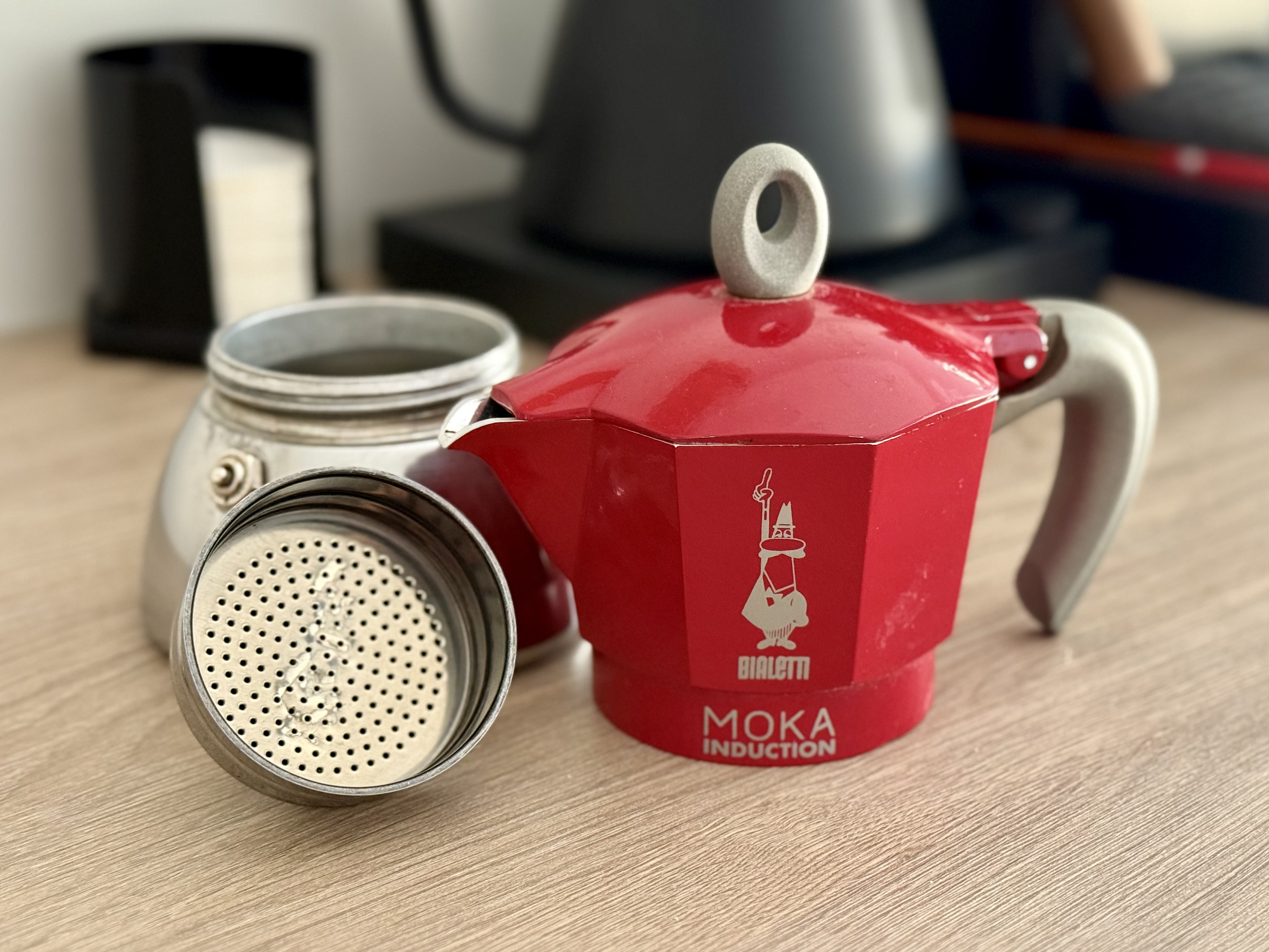
Bialetti Induction 4-cup Moka
Final Grind
62 clicks on Kingrinder K6
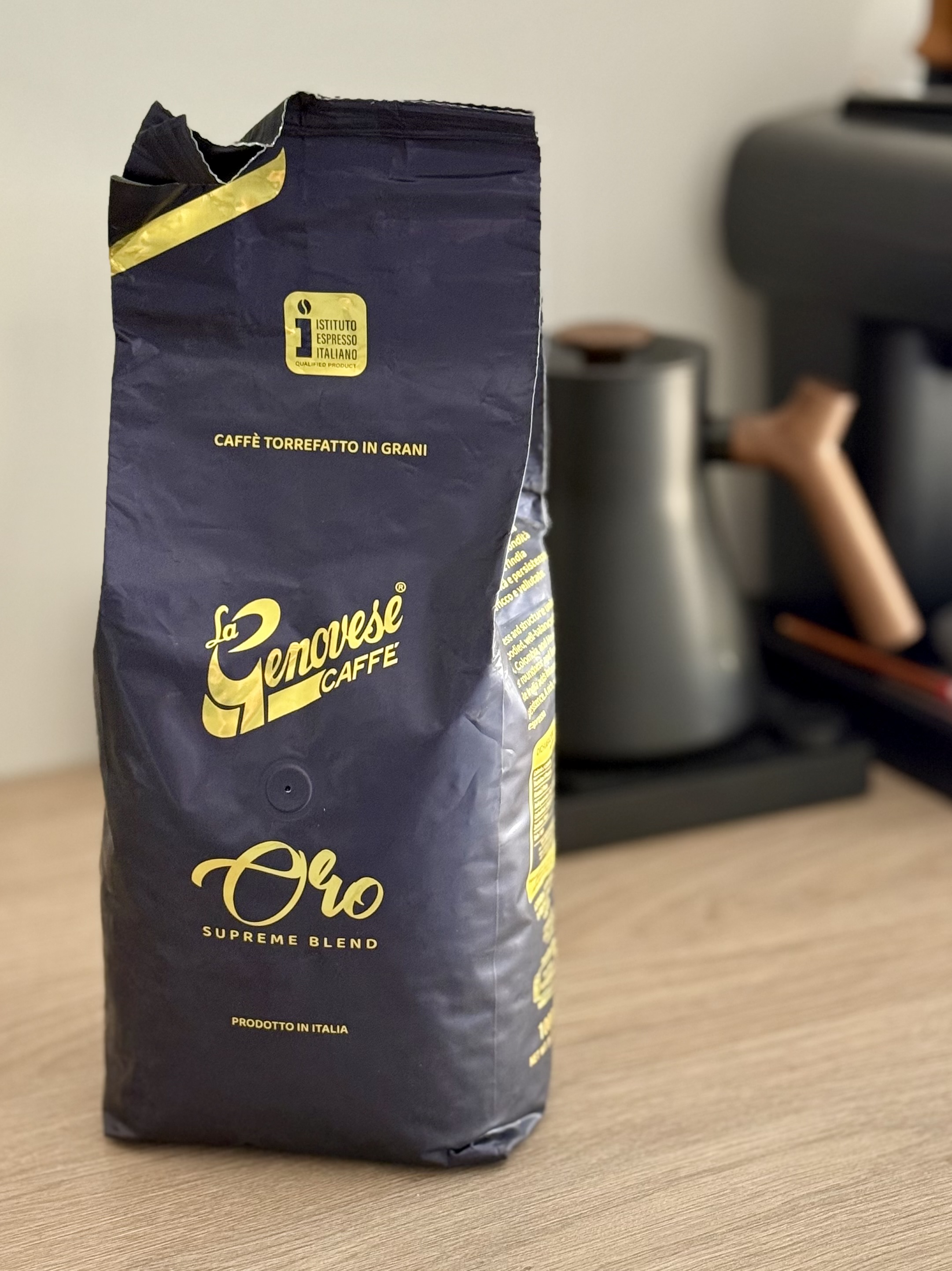
I bought a one-kilogram bag of La Genovese Oro Supreme Blend with one idea in mind: espresso.
It felt like the obvious choice. A medium-roasted Italian coffee blend, created with coffees from Central and South America and India, with a profile that seemed made for something rich, round, and comforting. On paper, it sounded like the kind of coffee I would enjoy as an espresso: chocolate, toasted nuts, warm spices, maybe that classic Italian structure that feels familiar even before tasting it.
But coffee does not always follow the plan we have for it.
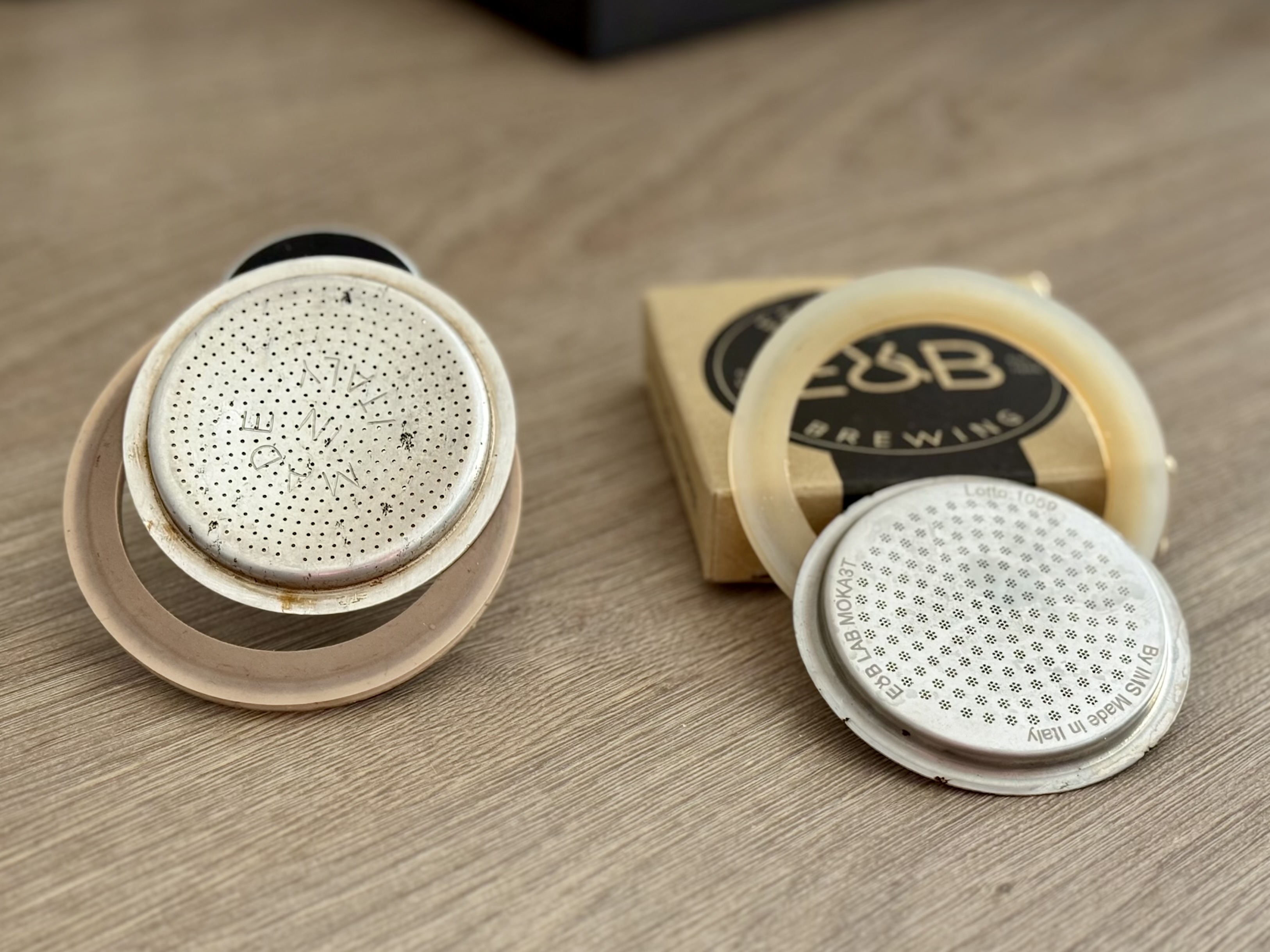
I went on vacation, and during those days I did not have my espresso setup with me. What I had was my 4-cup Bialetti induction moka pot, my Kingrinder K6, and a new little piece of equipment I was very curious to test: the E&B Lab Competition Moka Filter.
So this coffee, originally bought for espresso, became something different. It became a moka experiment. And maybe that was even more interesting.
“The first recipe does not need to be right. It only needs to teach you something.”
A coffee bought for espresso, tested with a moka pot
During these last months, I have slowly been trying to understand the moka pot better. Not as a nostalgic object, not only as the coffee maker many of us know from home, but as a real brewer, with its own logic and its own sensitivity. The more I use it, the more I realize that the moka pot is simple only on the surface.
You can use it casually, of course. But if you start paying attention, it becomes a small laboratory.
Grind size, water quantity, dose, heat, distribution, filters, timing — every variable changes something. Sometimes in a very small way. Sometimes completely.
This test with La Genovese Oro Supreme Blend was not just about finding a good recipe. It was about seeing if the ideas I had built little by little with my moka pot could actually help me improve the cup.
The coffee
A medium-roasted Italian coffee blend
La Genovese Oro Supreme Blend is not the kind of coffee I usually associate with my most recent V60 or specialty coffee experiments.
It is more classic. More comforting. More oriented toward body, sweetness, chocolate, nuts, and spices rather than bright acidity or floral notes.
And that is exactly why I found it interesting. Sometimes I am not looking only for clarity or complexity. Sometimes I want to understand how to make a more traditional profile cleaner, more balanced, and more precise.
Why moka?
Keeping the classic character, improving the clarity
The moka has a strong personality. It can make coffee intense, warm, and round, but it can also easily become bitter, dry, heavy, or muddy if the recipe is not well controlled.
With this coffee, I wanted to see if I could keep the classic character of the blend while improving the clarity of the cup.
A new filter, and one more variable to understand
I used the E&B Lab Competition Moka Filter from the beginning of the experiment. The idea behind this filter is very interesting: reduce the amount of fine particles that end up in the cup, and help the moka produce a cleaner and more balanced drink.
I liked the idea very much because one of the things I have been learning with the moka pot is that bitterness does not always come from the same place.
Sometimes bitterness comes from over-extraction. Sometimes from too much heat. Sometimes from fines. Sometimes from a coffee bed that is not distributed well. And sometimes from a combination of everything.
So this test became a way to understand not only the coffee, but also the role of filtration.
My vacation setup
This whole experiment happened in a rented house during vacation.
That detail matters. I was not in my usual kitchen. I was not using my gas stove. I was using an induction hob, set at level 5 out of 9, with my 4-cup Bialetti induction moka pot.
The water was filtered and at room temperature. I used a dosing funnel, distributed the grounds with WDT, tapped lightly to settle the coffee bed, and then leveled everything without tamping.
This is an important part of my moka routine now. I do not want to press the coffee bed like espresso. The moka pot does not work like espresso, and I do not think it should be treated as a small espresso machine.
Distribution
Dosing funnel, WDT, light tapping to settle, then careful leveling without tamping.
Water
Filtered water at room temperature, progressively reduced from 165 g to 100 g.
Heat
Induction hob at 5/9. I moved the moka away once the bottom was covered and the flow became stable.
Reference
I started five clicks coarser than my Kimbo Espresso Napoli reference on the Kingrinder K6.
The progression
Five tests, one cup getting better
Test 1
Too watery, but useful
17.2 g coffee / 165 g water / 65 clicks K6
The taste was pleasant, but the cup lacked concentration. The flavor was there, but stretched too far.
Test 2
More aroma, small bitterness
19 g coffee / 120 g water / 60 clicks K6
The coffee became more aromatic and quite balanced, but a small bitter aftertaste appeared at the end.
Test 3
The first cup that made sense
20.2 g coffee / 100 g water / 60 clicks K6
More intense, more aromatic, more balanced. Reducing the water gave the cup more focus and structure.
Test 4
Cleaner, but not fixed
20.2 g coffee / 100 g water / 60 clicks K6 + AeroPress filter
The paper filter made the cup much clearer, but the small bitter note remained. Filtration improved clarity, but it was not magic.
Test 5 — Best cup
Two clicks changed everything
19.8 g coffee / 100 g water / 62 clicks K6 + AeroPress filter
Very good, aromatic, clean and clear, with intense notes of chocolate, toasted hazelnuts and spices.
Test 1 — a good taste, but too diluted
The first test was 17.2 g of coffee, 165 g of water, and 65 clicks on the K6.
I filled the funnel completely, which gave me around 17 g of coffee, and filled the boiler just below the valve with about 165 g of filtered water.
The result was too watery. But not bad. And that is an important difference.
The coffee had a pleasant taste. It was not unpleasant, not empty, not completely wrong. But it lacked concentration. It felt like the flavor was there, but stretched too far.
Test 2 — more aroma, but a small bitter shadow
The second test was 19 g of coffee, 120 g of water, and 60 clicks on the K6.
This time, I increased the dose, reduced the water, and ground a little finer. The coffee immediately became more aromatic. At the nose, it was much more expressive. It had more presence, more character, and more of that warm profile I expected from this blend.
In the cup, it was light but quite balanced. Still, there was a small bitter aftertaste. Not a huge bitterness. Not the kind of bitterness that ruins the cup. More like a little shadow at the end, enough to tell me that the recipe was not fully where I wanted it to be.
If a coffee tastes light, the temptation is often to grind finer. But because I already had a small bitter note, I did not want to push extraction further through the grind. So for the third test, I kept the grind the same. I changed the water instead.
Test 3 — the first cup that really made sense
The third test was 20.2 g of coffee, 100 g of water, and 60 clicks on the K6.
This was the first cup that made me think: okay, now we are close.
The coffee became more intense, more aromatic, and more balanced. Reducing the water to 100 g made a big difference. The cup felt more focused, more structured, and more satisfying.
This was probably the first real lesson of the experiment. In moka brewing, reducing water can improve concentration without necessarily making the coffee harsher. It depends on how the other variables are managed.
Test 4 — the paper filter made the cup cleaner, but did not erase the bitterness
The fourth test was 20.2 g of coffee, 100 g of water, 60 clicks on the K6, and one AeroPress paper filter.
For this test, I humidified the E&B Lab metal filter and placed an AeroPress paper filter against it before assembling the moka. This was a small experiment inside the experiment.
The result was clear: the cup became much cleaner. It was similar to the third test, but visually and sensorially clearer. The texture felt lighter, and the profile was more transparent. It was like the coffee had been polished.
But the small bitter note was still there. The paper filter improved clarity, but it did not fix everything. This told me that the bitterness was not only coming from fines in the cup.
Best result
Test 5 — two clicks changed everything
The fifth test was 19.8 g of coffee, 100 g of water, 62 clicks on the K6, and one AeroPress paper filter.
This was the best cup.
The dose stayed around 20 g. The water stayed at 100 g. The E&B Lab filter stayed in place. The AeroPress paper filter stayed too. The only real change was the grind: two clicks coarser.
And those two clicks changed the balance.
The coffee became very good. Aromatic, clear, clean, and much more enjoyable. The cup had intense notes of chocolate, toasted hazelnuts, and spices. It kept the warm and classic identity of the blend, but with a cleaner and more controlled expression.
Lessons from the cup
What this test taught me
01
Water matters
The difference between 165 g, 120 g, and 100 g was not just volume. It changed the whole cup.
02
Filtration is not magic
The paper filter improved clarity, but it did not remove the bitter note by itself.
03
Two clicks can matter
Moving from 60 to 62 clicks on the K6 was enough to make the cup cleaner and more balanced.
04
The moka rewards patience
A good recipe is built cup after cup, by changing one variable at a time.
My current recipe
La Genovese Oro Supreme Blend in my 4-cup moka
Coffee
La Genovese Oro Supreme Blend
Moka pot
Bialetti induction 4-cup
Metal filter
E&B Lab Competition Moka Filter
Paper filter
1 AeroPress paper filter, placed against the humidified metal filter
Dose
19.8–20 g coffee
Water
100 g filtered water at room temperature
Grind
62 clicks on the Kingrinder K6
Heat
Induction hob at 5/9
The result is a clean, aromatic and clear moka cup, with notes of chocolate, toasted hazelnuts and spices.
A recipe that will probably change
There is one thing I want to be honest about.
This recipe was created during my vacation, on an induction hob in a rented house.
When I go back home, I will use my gas stove again. And I already know that something will change.
Gas and induction do not behave in the same way. The heat transfer is different, the response of the moka pot is different, and the moment when I need to remove the brewer from the heat may also change.
So I do not see this recipe as an absolute truth. I see it as the best recipe I found in that specific context.
And honestly, I like that. Because the more I learn about coffee, the more I realize that recipes are not fixed answers. They are snapshots of understanding. They show where you were, what you noticed, and how you reacted to the cup in front of you.
This coffee started as an espresso idea. But it became a moka lesson.
La Genovese Oro Supreme Blend gave me the perfect opportunity to test what I had been learning: how water changes concentration, how filtration changes clarity, how grind size changes balance, and how the moka pot can become much more precise when treated with attention.
The final cup was not only better than the first one. It was cleaner, more aromatic, more balanced, and more intentional. And for me, that is exactly what makes this little moka journey worth writing about.
Your turn
Two questions for you
Have you ever used a coffee bought for espresso in a moka pot instead?
When dialing in your moka pot, do you usually adjust the grind first, or the amount of water in the boiler?
 Antonio's Coffee Journey
Leave a comment