
Grinder Journey · First Impressions
Finding Clarity at 9.6
My first weeks learning the Fiorenzato Pietro with M burrs
This is not a definitive grinder review. It is the story of why I started looking for greater clarity, how the Pietro changed my V60s, and why its adjustment scale initially made very little sense to me.
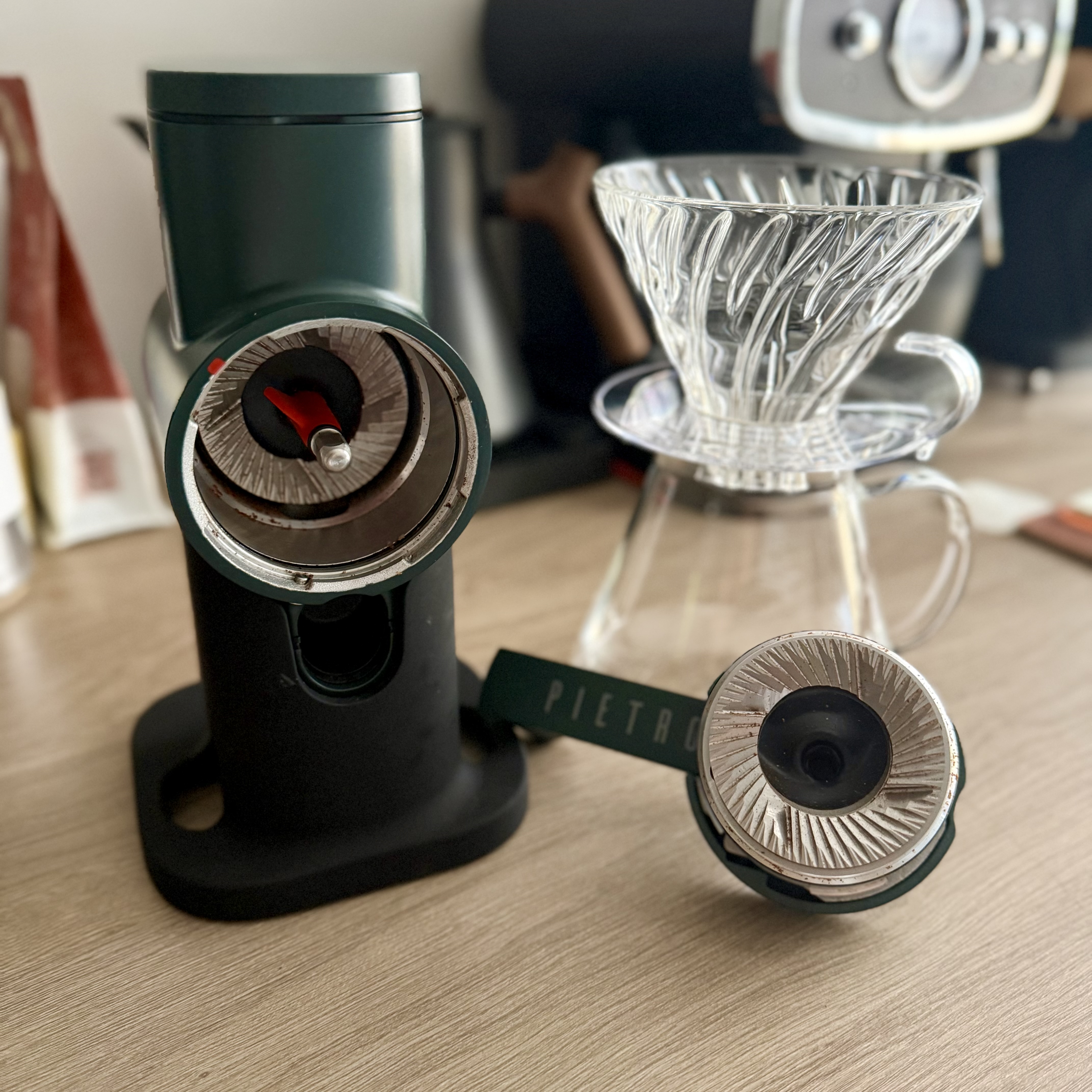
The Fiorenzato Pietro gradually became my dedicated manual grinder for pour-over coffee.
A beginning, not a verdict
This is not a definitive review of the Fiorenzato Pietro.
I have not used it for long enough, I have not explored its entire range, and there are still parts of its adjustment system that I am trying to understand. I have not tested every brewing method, every roast level or every possible way of using its M burrs.
What I can describe, however, is the moment when my pour-over coffee began to feel noticeably clearer.
And strangely enough, that moment arrived very close to the end of the grinder’s scale.
Where the search began
The Problem Was Not Always My Recipe
Before the Pietro, my main manual grinder was the KINGrinder K6.
The K6 taught me a great deal. It helped me understand grind size, extraction, pouring technique and the way a coffee changes when one variable is adjusted at a time. It remains an important part of my setup, and I have no intention of getting rid of it.
But as I spent more time with the V60, I began encountering a problem that I could not completely solve through technique.
Sometimes, even when the recipe appeared correct, the cup still felt confused.
The aromas were there, but they were difficult to separate. A coffee could taste bitter and underdeveloped at the same time: some particles appeared to be giving too much, while others were not giving enough.
This became especially noticeable when I moved the K6 towards coarser settings. In my experience, it produced enough fines to influence the extraction even when the general grind size was relatively coarse.
“The result was not necessarily a bad cup. It was simply a cup that was difficult to read.”
Why I Did Not Start with a Sieve
At first, I wondered whether I could solve the problem by sifting the ground coffee.
The idea made sense in theory: remove part of the fines and obtain a more uniform coffee bed. But I soon realised that sifting is useful only when you understand exactly what you are trying to remove.
Question one
Which particle size was causing the problem?
Question two
How much of the ground coffee should I remove?
Question three
At what point would I begin changing the coffee itself?
I did not know the answers.
Instead of trying to repair the grind distribution after producing it, I began looking for a grinder capable of producing fewer fines from the beginning.
A memory from Paris
Remembering a Grinder from the Paris Café Festival
My research gradually brought me towards grinders with flat burrs designed specifically for filter coffee.
I was not looking for another electric grinder. I already had an electric Fiorenzato with multipurpose burrs, and I wanted something manual that could become my dedicated pour-over grinder.
Then I remembered the Paris Café Festival.
At the Fiorenzato stand, I had seen a rather unusual manual grinder being demonstrated. It had a vertical body, a large side handle and flat burrs. They were using it to prepare pour-over coffee.
That grinder was the Pietro.
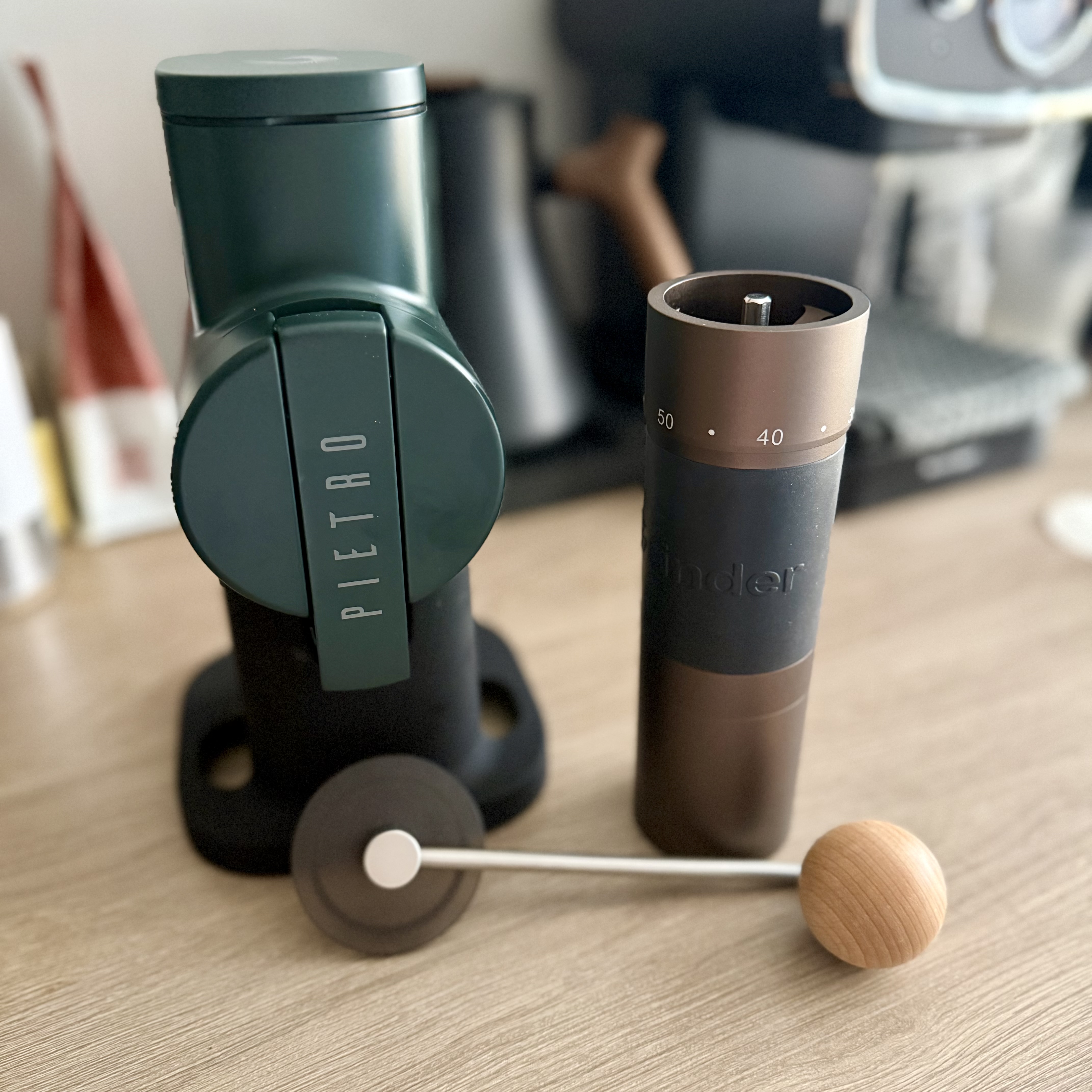
The K6 and the Pietro remain part of the same setup, but they now serve different purposes.
Choosing the M burrs
Looking for Clarity from the Beginning
At the festival, I had observed the Pietro with curiosity, but I had not yet understood why it might be relevant to me. Months later, while searching for a grinder capable of producing a more uniform grind with fewer fines, I realised that the answer might have already been in front of me.
The version with the M burrs seemed particularly aligned with what I wanted.
My objective was not more body or a more traditional, blended flavour profile. I wanted clarity. I wanted to be able to distinguish one aromatic direction from another without the cup becoming hollow or thin.
Most importantly, I wanted adjustments to matter.
The first cups
The First Difference Was Immediate
I expected the difference between the K6 and the Pietro to be noticeable from the beginning.
It was.
The Pietro did not simply give me a slightly better version of the same cup. It changed the way the coffee responded to adjustments.
With the K6, there had been moments when I could make a relatively large grind change and still obtain two cups that felt surprisingly similar. With the Pietro, smaller changes began to produce recognisably different results.
“The Pietro does not only make the coffee clearer. It makes the consequences of my decisions clearer.”
Learning the adjustment system
A Simple Dial with Confusing Numbers
Physically, the adjustment dial is easy to use.
You turn it, align the number with the indicator and select the desired position. If you did not care about recording a numerical setting, you could simply remember where the dial was and continue brewing.
The confusion begins when you want to be repeatable.
An example: setting 8.7
The number 8 is simple. I turn the dial until 8 reaches the white indicator.
But where is 0.7?
Initially, I assumed that every click represented 0.1. That seemed logical. The scale uses decimal numbers, so I expected the clicks to follow the same decimal progression.
But between 8 and 9, I could feel only five positions. That was the first moment when the numbers stopped making sense.
After thinking about it and searching for an explanation, I understood that each perceptible step represented 0.2. Starting from 8, the successive positions correspond to 8.2, 8.4, 8.6 and 8.8 before reaching 9.
This means that 8.7 is not one of those perceptible positions. To reach it, I would move three steps beyond 8 to arrive at 8.6, then position the indicator halfway between 8.6 and 8.8.
Once understood, the scale becomes much easier to read. But it creates another question that I have not yet answered.
If the dial is positioned between two perceptible positions, could the adjustment move while I am grinding?
For the moment, I have avoided this uncertainty by using only the positions that I can feel clearly. I have not yet needed the intermediate settings.
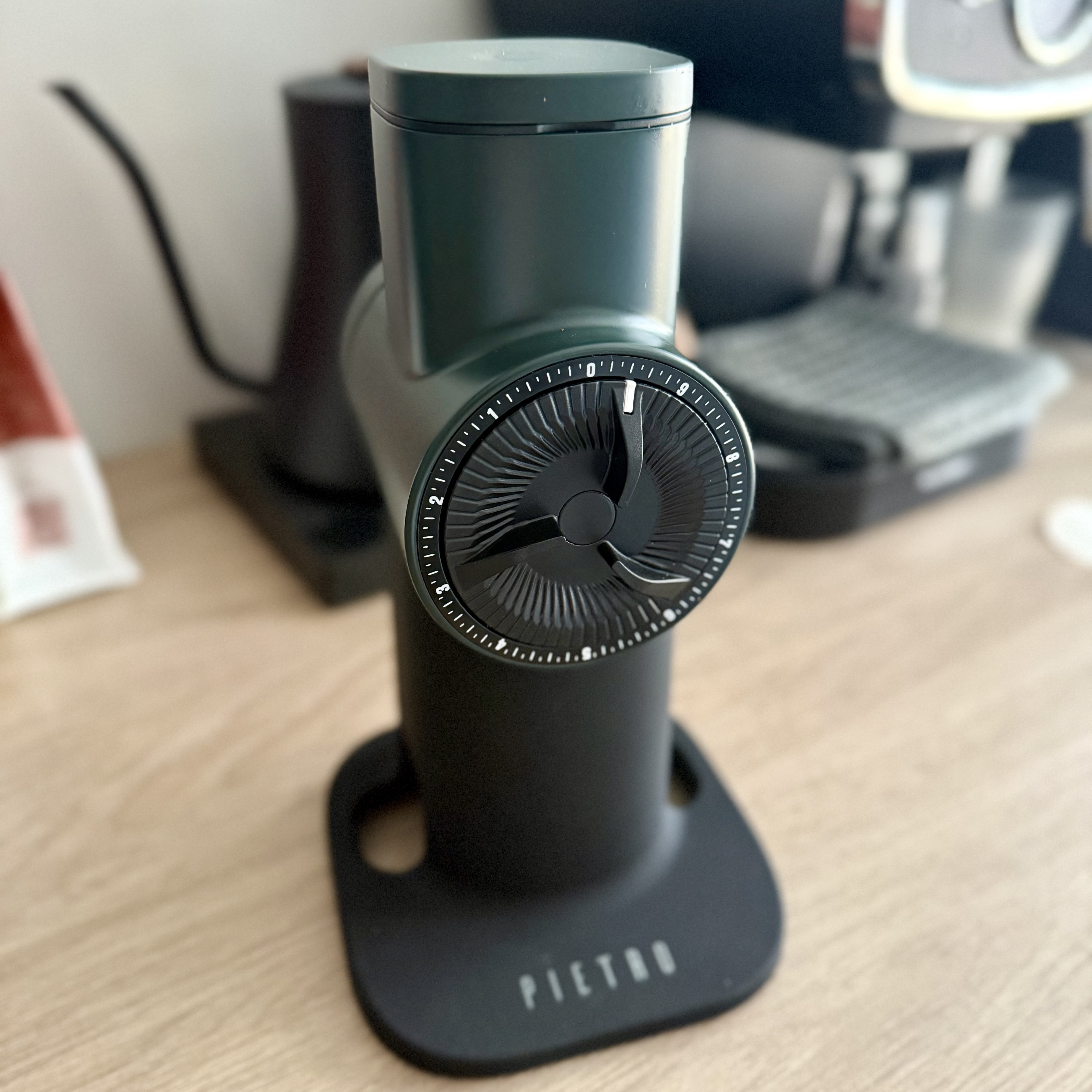
At 9.6, the adjustment reaches its physical end stop.
No more room to turn
The End of the Dial
My Pietro stops at 9.6.
This is not simply the highest number I have chosen to use. At 9.6, the adjustment reaches its physical end stop. The dial cannot continue any further.
For the coffees I have brewed so far, this has not prevented me from obtaining excellent results. In fact, one of my best recipes uses exactly 9.6.
But knowing that I am already at the end of the available range makes me slightly uncomfortable.
What If I Need to Go Coarser?
What happens when I begin brewing a very lightly roasted coffee that requires an even coarser grind?
What happens if I change my pouring technique, increase the dose or use another brewer that benefits from a more open setting?
At the moment, these are hypothetical problems. I have not yet prepared a coffee that genuinely required me to go beyond 9.6.
Still, the fact that there is nowhere else to go remains in the back of my mind.
In my current use, V60 settings have generally fallen between approximately 7 and 9.6. The numbers are not preventing me from making good coffee. They simply leave me wondering whether the available range will always be enough.
The opposite end
Understanding Zero
The other end of the scale created a different kind of confusion.
When my Pietro was initially set to zero, the burrs were completely locked. Even with the grinder empty, I could not rotate the handle without forcing it.
From what I understood during my research, zero should correspond to burr contact, but not to a condition in which the mechanism is impossible to rotate.
Before calibration
The burrs were in contact and the handle could not rotate.
After calibration
The burrs still touch at zero, but the handle can rotate without excessive force.
This also helped me understand how important correct assembly is.
The moving burr has a reference mark that must align correctly with the reference on the grinder body. If the burr carrier is installed incorrectly, or if the zero point is poorly calibrated, the same number on the dial may no longer correspond to the same effective grind size.
The dial may still stop at 9.6, but the coffee produced at 9.6 could be considerably finer or coarser depending on how the grinder has been assembled and calibrated.
This is why comparing Pietro settings between different users may be more complicated than simply exchanging a number. The number is useful only when the grinder behind it has a reliable zero point.
I am now comfortable with the calibration of my own Pietro. The zero point itself no longer worries me.
The coarse limit still does.
First successful V60s
Three Coffees That Changed My Perspective
I reached satisfying recipes surprisingly quickly. For each coffee, approximately two attempts were enough to find a cup that I considered genuinely good.
My pouring technique remained the same, I used Cafec T90 filters, and the total brew time was generally around 1 minute and 50 seconds.
These recipes are not universal recommendations. They are simply examples of where the Pietro began working for me.
Coffee 01 · Colombia
Terres de Café
Santa Maria
Caturra & Castillo · Washed
15 g coffee
210 g brewing water
15 g bypass
88°C
Pietro: 9.6
The bypass helped me adjust the final intensity without continuing to extract through the coffee bed.
The cup was balanced, clear and much easier to understand than my earlier attempts.
The recipe worked. The fact that it required the maximum setting still made me hesitate.
Coffee 02 · Colombia
Terres de Café
Buenos Aires
Pink Bourbon · Natural
15 g coffee
225 g water
90°C
Pietro: 9.0
This was one of the coffees through which I could most clearly appreciate the Pietro’s aromatic separation.
The flavours no longer felt compressed into one general fruity impression. The coffee became more open, allowing me to follow its different sensations as the cup cooled.
Coffee 03 · Mexico
Gud Coffee Lab
Typica
Typica · Washed
15 g coffee
210 g water
90°C
Pietro: 9.2
The most important improvement was not the appearance of one completely new flavour. It was the way the existing flavours stopped competing with one another.
The cup felt cleaner, more controlled and less confused.
Across all three coffees, the same pattern appeared: greater balance, greater clarity and more obvious separation between aromas.
Two grinders, two roles
Not a Replacement for the K6
Despite these differences, I do not consider the Pietro a replacement for the K6.
They will have different roles in my setup.
The Pietro is becoming my dedicated pour-over grinder. Its M burrs give me the type of clarity and separation that I was specifically looking for.
The K6 will remain useful, particularly for moka. With moka, I often appreciate the body and more blended flavour profile that the K6 can produce. The characteristics that became limiting for me in V60 are not necessarily disadvantages in every brewing method.
Comparing the two grinders only by asking which one is “better” would miss the point. They are not giving me two different levels of the same result. They are giving me two different types of result.
Daily workflow
Grinding with the Pietro
The Pietro is solid, substantial and unusual.
I personally enjoy its ergonomics, although I understand why it may not suit everyone. It does not feel like a conventional cylindrical hand grinder. It asks to be placed on a surface and used through its large vertical handle.
With approximately 15 grams of medium-roasted coffee, grinding generally takes less than one minute, although the exact effort depends on the coffee and its roast level.
Most of the time, the movement is smooth. Occasionally, however, a particularly resistant bean interrupts the rhythm. The handle can stop suddenly, requiring a little more force before the burrs continue through it.
This is not a major problem for me, but it is part of the experience.
Grinding time
Generally under one minute for 15 g
Retention
Very low in my current workflow
Build quality
Solid, imposing and reassuring
The workflow is slightly slower than with the K6, but the difference is small enough that I rarely think about it. The result in the cup is so different that comparing the two only by grinding speed would not be especially meaningful.
The journey continues
What I Still Need to Learn
These first weeks have been extremely positive, but they have not answered every question.
I still need to understand whether I will ever require settings beyond 9.6.
I want to test much lighter roasts, particularly coffees that may benefit from coarser grind sizes and high-extraction pour-over techniques.
I also want to explore the positions between the perceptible steps and understand whether they remain stable while grinding.
I have also come across a possible modification that appears to remove the coarse adjustment limit. I have not attempted it, and I am not yet certain that I will.
Modifying a new grinder simply because I might encounter a limitation in the future would be premature.
But if a very light coffee eventually pushes me against the end stop, I may need to investigate the possibility more seriously.
For now, I prefer to continue brewing.
First conclusion
A Very Positive Beginning
The Pietro has already achieved the main thing I hoped it would do.
It has made my coffees clearer.
It has helped separate aromas that previously seemed compressed together, and it has reduced the sensation of a cup being simultaneously overextracted by fines and underextracted by larger particles.
Most importantly, it has made adjustments meaningful.
A change on the dial now feels like a real change in the cup.
I am still learning how to read the numbers. I am still working close to the end of the scale, and I do not yet know whether 9.6 will eventually become a genuine limitation.
But this is exactly why I do not want to call this a review.
It is the beginning of a relationship with a grinder that has already shown me more of the coffee, even before I have fully understood the grinder itself.
Sometimes the cup begins to make sense before the numbers do.
Now I would like to hear from you
What Has Your Grinder Taught You?
Have you ever used a grinder whose adjustment scale was more confusing than the coffee it produced?
Have you ever reached the end of a grinder’s range while still feeling that you wanted to go further?
Share your experience in the comments. I am still learning the Pietro, and I would be very interested to compare our approaches.
 Antonio's Coffee Journey
Leave a comment