
Marsellesa Through the AeroPress
After V60 and moka, there was still one side of Gud Coffee Lab’s Marsellesa I wanted to explore: immersion.
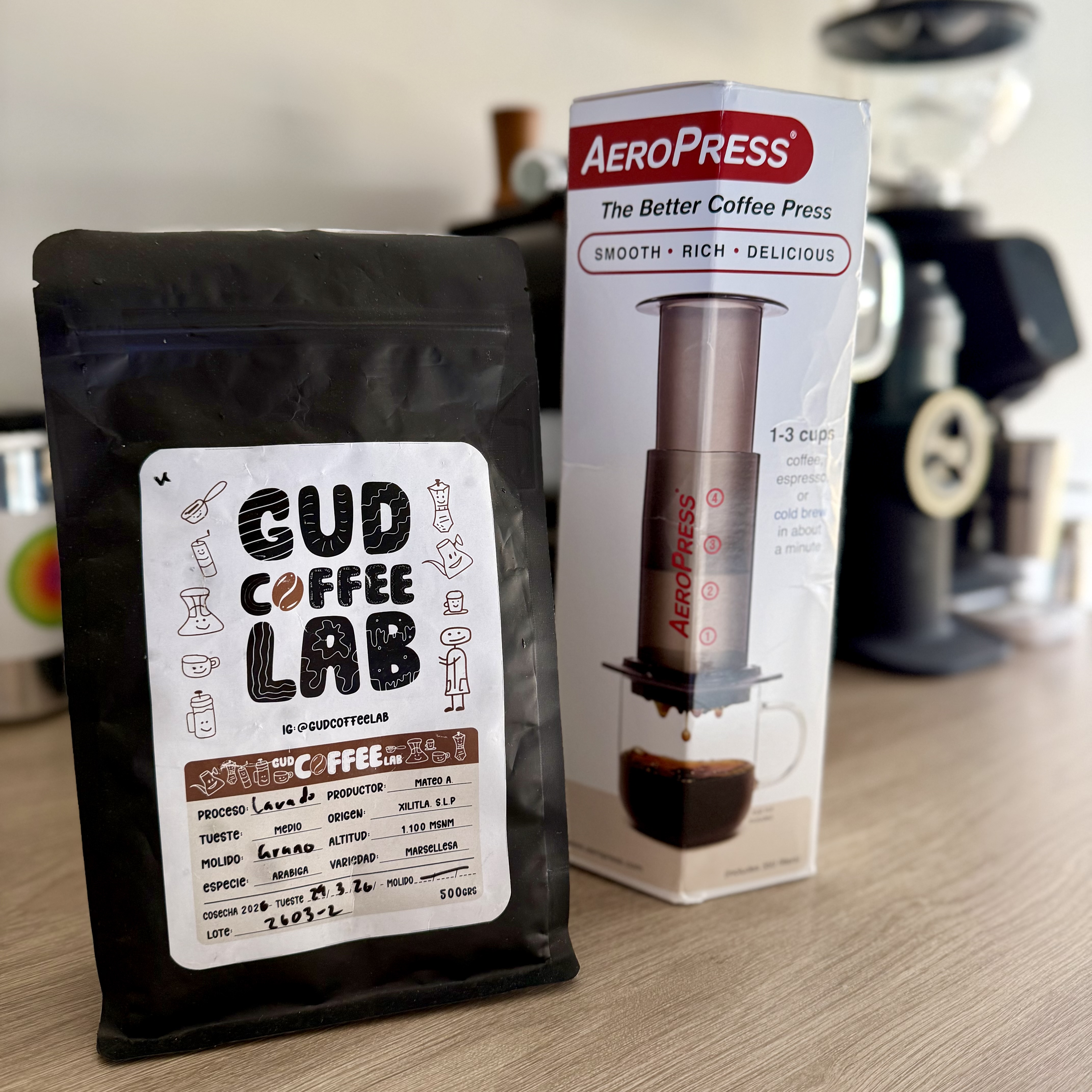
The third and final brewing method of my first journey with Gud Coffee Lab’s Marsellesa.
When I first started brewing the coffees from Gud Coffee Lab, I already had a small idea in mind.
I did not want to taste them through only one brewing method.
I wanted to take the same coffee and move it through three very different ways of preparing it: V60, moka and AeroPress.
Not because I was looking for a winner, and not because I thought one method would necessarily reveal the coffee better than the others.
I simply wanted to understand how much the brewing method could change my perception of exactly the same beans.
Why the AeroPress?
By this point, the Marsellesa had already taken me through two very different cups.
The V60 had shown me its sweeter and fruitier side. The moka had taken the same coffee somewhere more intense, with stronger aromatics and a more pronounced acidity.
The AeroPress was the missing piece.
One of the things I wanted to explore from the beginning was immersion.
The V60 is fundamentally a percolation brewer. Water continuously moves through the coffee bed, and changes in pouring technique, grind size, temperature and flow rate can have a considerable effect on the final cup.
The moka behaves in a completely different way again, producing something considerably more concentrated and intense.
The AeroPress sits somewhere else: immersion combined with paper filtration, followed by a controlled press. Before starting, I imagined it might produce something somewhere between the V60 and the moka.
There was another reason for choosing the AeroPress.
Speciality coffee can sometimes appear unnecessarily intimidating from the outside.
Expensive grinders, complex espresso machines, precision accessories and an endless number of variables can easily make good coffee look like something accessible only after investing a considerable amount of money.
An AeroPress is relatively inexpensive, compact and accessible. If it could reveal another convincing expression of the same Marsellesa, it would reinforce something I increasingly believe: you do not need extraordinary equipment to start discovering what a good coffee has to say.
What I Already Knew About the Marsellesa
The sweeter side
My reference recipe had settled around 15 g coffee, 225 g water, 89°C and approximately 87 clicks on the KINGrinder K6, or around 8.6 on the Fiorenzato Pietro.
Earlier brews could become bitter and aromatically weak, but once the extraction worked, the V60 showed the Marsellesa’s sweeter, fruitier and more delicate side.
The louder side
With roughly 15.4 g of coffee and a considerably finer grind around 37 clicks on the K6, the moka took the same beans somewhere very different.
The cup became more intense and aromatic, while still remaining balanced, with a small but clearly perceptible acidity.
My First AeroPress Attempt
For the first recipe, I stayed with the familiar 15:225 ratio and chose the settings intuitively, based on previous AeroPress recipes I had already tried.
Water: 225 g
Temperature: 91°C
Grinder: KINGrinder K6
Grind: 90 clicks
Method: Traditional
Filter: AeroPress paper
0:40 — Continue to 225 g
1:20 — Insert the plunger
1:30 — Begin pressing slowly
2:20–2:30 — Finish the brew
The idea itself seemed reasonable.
The result was not.
Or, more precisely, it was not completely wrong.
The first sip already suggested that there were aromatics hiding somewhere underneath the extraction. The coffee felt as though it wanted to become interesting.
Unfortunately, bitterness was speaking much louder. It dominated the cup and obscured most of the character I had already discovered with the other brewing methods.
A small detail: the paper filter
The filter I used had already been brewed through twice and rinsed between uses.
I began wondering whether retained fines could have increased resistance and contributed to the bitter character of the cup.
I cannot say with certainty that the filter was responsible. The grind was relatively fine and the brewing temperature was also higher than where I would eventually end up. Still, it was another useful variable to keep in mind.
Adjusting the Recipe
Rather than treating that first cup as a failure, I treated it as information.
Across the following brews, I concentrated mainly on two variables: grind size and temperature.
I kept the same 15 g dose and 225 g of water. I did not introduce complicated stirring routines or radically different ratios. I simply moved progressively coarser and lowered the temperature.
The recipe that finally made sense
Water: 225 g
Temperature: 88°C
Grinder: KINGrinder K6
Grind: 105 clicks
Method: Traditional
Filter: Paper
0:00 — Gentle swirl to level the bed
0:30 — Insert the plunger
1:25 — Begin pressing slowly
Finish — Stop at the first hiss
A Much More Balanced Cup
This was where the AeroPress began to make sense for the Marsellesa.
The bitterness that had dominated the first brew was no longer controlling the cup.
Instead, the coffee became much more balanced, aromatic and clean.
There was a clarity that reminded me more of the V60 than of the moka, but without becoming as delicate.
At the same time, it had considerably more aromatic intensity than my V60 brews. This was very close to what I had originally hoped the AeroPress might provide.
The Grind Was the Main Variable
If there is one technical lesson I would take from these AeroPress tests, it is the importance of grind size.
Temperature mattered. Technique mattered. But grind size was the variable that most clearly changed the direction of the extraction.
Moving from 90 clicks to 105 clicks on the K6 helped transform a bitter and restrained cup into something considerably more balanced.
That lesson became even clearer when I later repeated essentially the same recipe using the Fiorenzato Pietro.
At around 8.6 on the Pietro, the coffee became even cleaner and more distinct. The recipe itself had not suddenly become more complicated. The biggest difference was simply the grind.
The Same Coffee, Three Different Voices
After all three brewing methods, I no longer think it makes much sense to ask which one reveals the “true” Marsellesa.
More space
Sweeter, fruitier and more delicate. The method I would choose when I want to explore the lighter and more transparent side of the Marsellesa.
More clarity
Cleaner and more balanced than the moka, but more aromatically immediate than the V60. A convincing meeting point between immersion and filtration.
More intensity
The loudest expression: more concentrated, intensely aromatic and with particularly enjoyable acidity. Personally, still my favourite of the three.
So Which Method Was Best?
I do not think there is a useful answer.
And after this series, I am even less interested in finding one.
All three methods were repeatable once their recipes were understood. All three showed me something worthwhile.
The V60 gave me sweetness and fruit. The moka gave me aromatic intensity and a more pronounced acidity. The AeroPress gave me cleanliness, balance and an interesting position between immersion and filtration.
Personally, I enjoyed the moka the most.
But that says more about the kind of cup I enjoy than about the objective quality of the extraction.
After tasting what the Marsellesa could do in the moka, I am even more curious about how it might behave as espresso with a more capable machine and greater control over the extraction.
A Coffee Does Not Need Expensive Equipment
This may actually be the most important conclusion of the entire Marsellesa series.
Speciality coffee does not begin with expensive equipment.
Better equipment can certainly help. A better grinder can make extraction more consistent. Better temperature control makes experiments easier to reproduce. More sophisticated brewers give us different ways to manipulate variables.
But none of those things creates curiosity.
Whenever the Marsellesa tasted excessively bitter or aromatically weak, I never considered that a problem with the coffee itself.
My first reaction was always to look at the extraction.
What had I done? What variable could I change? What did the previous cup teach me?
Completing the Marsellesa Journey
After V60, moka and AeroPress, I feel that I have finally drawn a fairly complete picture of the Marsellesa.
For me, it is a versatile, fruity and balanced coffee, with enough acidity to remain lively without becoming aggressive.
More importantly, it is a coffee capable of changing character quite dramatically depending on how it is brewed.
The same beans can become sweeter and more delicate in the V60, more concentrated and intense in the moka, or cleaner and more balanced in the AeroPress.
That, ultimately, was the reason for this experiment in the first place.
I wanted to see what happened when one coffee passed through three different brewing methods.
The answer is not that one brewer reveals the truth while the others distort it.
The answer is that each brewer reveals a different part of the same coffee. Perhaps understanding a coffee means accepting all of those interpretations rather than trying to reduce it to a single ideal cup.
The Marsellesa is now finished.
Literally, because I have no beans left.
But also because, for the moment, I feel that I have squared the circle.
There will always be another recipe to test, another grind setting to adjust or another extraction style to explore.
For now, though, this first journey feels complete.
From Marsellesa to Typica
The next coffee waiting for me is the Typica, also from Gud Coffee Lab.
Same producer. A new coffee. A new personality to understand. And, once again, three very different ways of listening to what it has to say.
 Antonio's Coffee Journey
Leave a comment