
Choosing My Next Espresso Machine: Understanding What I Actually Need
From the small machine that opened the door to espresso to a shortlist shaped by temperature, control and the way I now make coffee at home.
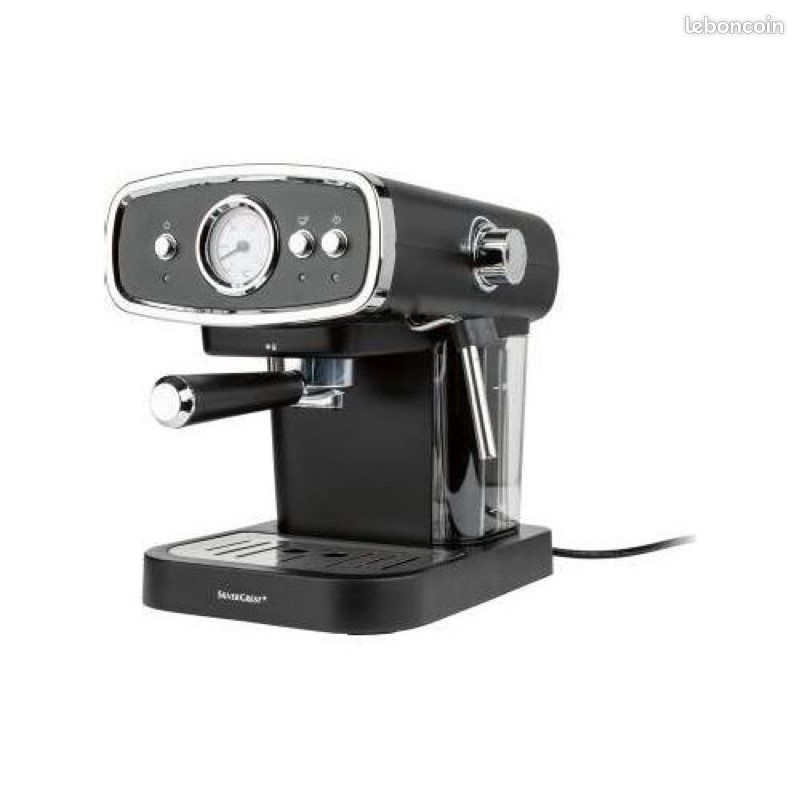
There are objects we keep because they perform perfectly, and others that remain important because of the person who placed them in our hands. My Silvercrest SEM 1050 B1 belongs, in its own way, to the second category.
My wife gave it to me around three years ago, when she was still my girlfriend and we had just moved in together. She had previously given me an induction moka pot when I first lived alone; later, seeing my curiosity grow, she chose this small machine so that I could discover espresso — and make espresso for her too.
It cost around €60, if I remember correctly, but its value had nothing to do with specifications. Espresso was already my favourite way to drink coffee, yet I knew almost nothing about extraction. The Silvercrest offered exactly what I needed then: an open door.
Three years later, I am considering closing that particular chapter. Not because the machine has failed, and not because I regret owning it, but because the questions I now ask of espresso are very different from the ones I had when it arrived.
This is not a review of the machine I may buy next, nor is it a guide to the best espresso machine for everyone. It is an attempt to understand what I actually need — and how I arrived there.
The machine that let me begin
My first coffees with the Silvercrest were made without a grinder. I used pre-ground Italian coffee from brands such as Kimbo, Passalacqua and Illy. I filled the pressurised basket, started the pump and watched espresso appear in the cup. There was no careful control of grind size, no precise temperature setting and very little understanding of what was happening inside the puck.
That simplicity was not a defect. It was what allowed me to start.
A pressurised basket creates resistance after the coffee bed rather than relying entirely on the coffee itself. With pre-ground coffee, that forgiveness was essential: it gave me something recognisable as espresso while I was still learning the language behind it.
Gradually, however, I began to look more closely. I started weighing the dose. I observed the time the coffee took to reach the cup. I noticed how a finer grind slowed the extraction, while a coarser one allowed the water to pass too quickly. Most importantly, I began connecting those changes to taste rather than treating time as a number to hit.
Pre-ground coffee
Kimbo, Passalacqua and Illy gave me an accessible first look at home espresso.
Cafflano Krinder & K6
Grinding at home made dose, resistance, time and flavour part of the same conversation.
AllGround Sense
Greater precision revealed more clearly what the machine could — and could not — do.
The better my grinder became, the easier it was to see that the machine was no longer allowing the coffee to show everything it had to offer.
For a long time, the pressurised basket had been helpful. With the AllGround Sense, it became the wall I kept reaching. I could make satisfying coffee with darker, traditional Italian roasts, especially when I accepted the machine on its own terms. But as soon as I tried to work with speciality coffees roasted lighter than medium-dark, the result stopped being convincing.
The problem was no longer simply finding a better grind setting. I had reached the point where greater precision before the extraction could not compensate for the lack of control during it.
When simplicity becomes a limit
The largest limitation of the Silvercrest is not the absence of a fashionable feature. It is more fundamental: I do not have a brew system capable of holding the water at a stable, controlled temperature throughout the shot.
The machine never feels truly thermally stable. The water temperature appears to change during the extraction, and I have no direct way to select or verify it. There is no pre-infusion to adjust, and I do not know exactly what pressure the machine is producing at the coffee bed.
Its steam wand can do a decent job with good technique, but preparing several drinks in succession is not its natural environment.
The coffees began asking for more
Temperature: stable and directly adjustable.
Roast range: beyond dark and medium-dark Italian profiles.
Repeatability: the same recipe, under the same conditions.
Capacity: several espressos and cappuccinos when people visit.
Longevity: parts, maintenance and a machine built for the long term.
None of this means the Silvercrest is a bad machine. It remains simple, approachable and perfectly capable of preparing dark-roasted Italian coffee for someone who does not want to turn every cup into an experiment. The difficulty is that this is no longer how I approach espresso.
Today, I want to choose a temperature for a particular roast, repeat a recipe the following morning, then deliberately change one variable at the weekend and understand what it has done.
For a brief contrast, my parents’ pre-millennium La Pavoni Professional — fitted with an IMS competition basket and a Bong Isolator — has shown me how much can be learned when grind, dose, pre-infusion and pressure remain in the user’s hands. It has also confirmed that I want manual involvement without having to manage temperature indirectly through a pressurestat.
That distinction became central to my search: I am not looking for a machine that removes me from the process. I am looking for one that gives me better conditions in which to take part.
One machine, two different rhythms
My ideal workflow changes depending on the day.
During the week
Consistency matters most. I would like to prepare at least one espresso in the morning and another when I return from work. My wife would use the machine too, following an established recipe without having to alter the settings.
Once a coffee has been dialled in, the machine should help us repeat it rather than force us to rediscover it every day.
At the weekend
I want freedom to change the temperature, try a lighter roast or explore pre-infusion. When friends or family visit, the machine must also prepare several espressos and cappuccinos without becoming overwhelmed.
Consistency creates a reliable starting point; manual control decides where I go from there.
The new machine will replace the Silvercrest completely. I do not have a strong attachment to it as a piece of engineering, and I have long known that I would replace it. Still, it was a gift from the person I love. Objects given to us by people we care about acquire something like a soul, and letting this one go is not entirely neutral.
Perhaps the right way to honour it is not to pretend that it still meets my needs. It is to recognise the journey it made possible.
Turning wishes into requirements
My initial budget of around €2,000 gradually moved towards €3,000 — not because I wanted more features, but because an intermediate machine could leave me asking the same questions again in a few years.
If I am going to make this investment, I want a machine that feels professional in its construction and that I can reasonably expect to keep for at least ten or fifteen years, perhaps longer. Spare parts, maintainability and the possibility of carrying out repairs myself matter almost as much as performance.
The research became much easier when I separated the characteristics that genuinely changed my workflow from those that merely looked attractive on a product page.
My Must-Haves
✓ A dual-boiler architecture
I want brewing and steam production to be managed separately, allowing me to choose a brewing temperature without treating milk steaming as the other side of the same compromise.
✓ Independent PID control
A PID cannot replace dialling in the grinder, but it can provide a controlled, repeatable thermal starting point across traditional and lighter speciality roasts.
✓ A manual E61 group
I want its thermal mass, thermosiphonic circulation, mechanical pre-infusion and parts ecosystem — but especially the gesture of starting and stopping the extraction myself.
✓ A rotary pump
Silence is welcome, but steady delivery, consistent pressure, professional construction and the option of direct plumbing matter more.
✓ Control without forced automation
I want the machine to stabilise the variables that are difficult to manage reliably, while leaving the decisions that shape the recipe to me. Temperature can be held accurately; starting and stopping the extraction should remain manual.
Features that can support the journey without defining the purchase
Flow control initially seemed essential. For now, I would rather learn the machine in its standard configuration before adding another variable. Direct plumbing is also a future possibility: I expect to begin with the reservoir, while developing a controlled water recipe from demineralised water and added minerals.
- Flow control later
- Shot timer
- Programmable switch-on
- Pressure gauges
- Clear digital interface
- Future direct connection
The shortlist: what each machine taught me
I looked at machines from Lelit, VBM and other manufacturers to understand what the wider market offered and at what level of investment. They were useful reference points rather than genuine finalists.
My actual path remained largely within the Bezzera range, where each model helped clarify one more requirement.
| Machine | Architecture | Group | Temperature | Pump | Flow control | Dimensions | Decisive compromise |
|---|---|---|---|---|---|---|---|
| Bezzera Magica S | Heat exchanger | Manual E61 | No independent brew control | Vibration | No | 300 × 425 × 415 mm | The pump no longer matched what I wanted from a long-term machine. |
| Bezzera Mitica Top | Heat exchanger | Manual E61 | Pressurestat | Rotary | No | 320 × 450 × 400 mm | It solved the pump question, but not temperature control or boiler independence. |
| Bezzera Aria Top PID MN | Heat exchanger | Manual E61 | PID | Rotary | Available | 250 × 428 × 411 mm | More control, but still based on one HX boiler. |
| Bezzera Sole Top PID MN | Heat exchanger | Manual E61 | PID | Rotary | Optional | 305 × 455 × 415 mm | The design drew me in, but the HX architecture remained. |
| Bezzera Duo Top MN | Dual boiler | Manual E61 | Two PID thermostats | Rotary | Not fitted in this configuration | 326 × 470 × 425 mm | Larger and more expensive, with flow control left for later. |
Magica S
My first favourite: the classic polished-steel prosumer machine I had imagined. Its vibration pump became the first compromise I was no longer willing to accept.
Mitica
A rotary-pump configuration answered the pump question, but solving one requirement only revealed the next: the heat-exchanger architecture remained.
Aria Top PID MN
Compact, manual and professionally equipped. PID control brought it closer to what I wanted, yet it was still based on a single HX boiler.
Sole Top PID MN
The favourite before the Duo. Its appeal was not purely rational: I simply loved its design. If the decision had been visual, the search might have ended here.
The La Pavoni Botticelli Evolution also appeared briefly because its rotary pump and approach to pre-infusion were interesting. Limited availability made it difficult to treat as a realistic long-term choice, particularly when parts and support matter.
The shortlist did not collapse because any of these machines was inadequate. It narrowed because every comparison made the role of the dual boiler more difficult to ignore.
Why the Duo moved to the front
I discovered the Bezzera Duo around three or four months ago, while trying to understand the real advantage of two independent boilers. It did not become the favourite immediately. The Sole still had the stronger emotional pull, particularly through its design. The Duo won ground more slowly, by answering one requirement after another.
Its 3.5-inch touch display manages temperatures, daily switch-on, adjustable pre-infusion, maintenance reminders and automatic backflushing. It can draw from a four-litre reservoir or be plumbed in later.
Those features do not make it the right machine by themselves. What makes them relevant is how they fit the way I intend to use it.
On weekday mornings, the machine can be ready at a planned time, with the brew temperature already established. My wife and I can follow the same recipe and expect the machine to provide the same conditions. At the weekend, I can change the temperature, explore pre-infusion and work deliberately with a different roast while keeping the steam system independent.
The electronics do not worry me or make the experience feel less manual. They govern the environment around the extraction; the E61 lever still leaves the extraction itself in my hands. That balance — sophisticated control behind a traditional physical gesture — is probably the clearest expression of what I have been trying to find.
The Duo is neither the smallest nor the cheapest machine I considered, but it fits my space almost perfectly. Raising my budget required me to ask whether I was paying for useful capabilities or merely a longer specification list.
In this case, the additional cost seems to buy the architecture I actually want rather than decorative complexity: separate brewing and steam boilers, independent temperature control, a rotary pump, a manual E61 group and a construction intended to sit at the professional end of the domestic market.
There is still a compromise. The configuration I am considering does not include flow control. But this no longer feels like a reason to reject the machine. I can learn how the Duo behaves in its standard form first; if lighter roasts eventually lead me towards flow profiling, that can become a later chapter.
An almost final choice — not yet a review
At the moment, the Bezzera Duo Top MN feels like an almost definitive choice. A completely unexpected favourite could still appear, but I no longer have a technical doubt waiting to be resolved. The remaining step is the decision itself.
That is why this article cannot be a review of the Duo. I have not yet lived with it, learnt its warm-up behaviour, tested its steam power, built water for it or discovered how its settings translate into the cup. All of that must wait until the machine is actually here and experience has replaced expectation.
For now, the most valuable result of the search is not the name of the likely winner. It is the understanding that came before it.
The Silvercrest taught me that espresso depends on dose and grind size, that flow can be read and that time only matters when connected to taste. Its pressurised basket helped me begin before I had the tools or knowledge to create resistance through the puck alone. Later, its limits taught me something equally useful: better equipment matters most when it allows new knowledge to become visible.
I am not looking for a machine that promises perfect espresso at the touch of a button. I am looking for a machine that can provide stable water, repeatable conditions and enough control for me to take responsibility for the result. During the week, I want consistency. At the weekend, I want questions. The same machine must make room for both.
If the Duo does become my next espresso machine, it will not erase what came before it. It will begin from everything the Silvercrest allowed me to learn — and open the next espresso chapter of Antonio’s Coffee Journey.
Whether you already own an espresso machine or are considering your first one, what matters most to you when choosing it?
What would you like your current or future espresso machine to help you discover about espresso?


Leave a comment